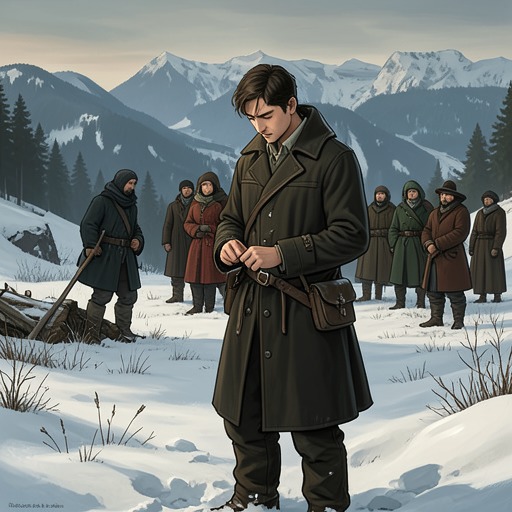
The Red Lion Inn thief breaks in and is captured
Hans Brinker, or The Silver SkatesThe Red Lion Inn thief breaks in and is captured during the boys’ stay in Leiden: a stealthy nighttime burglary turns into a test of nerve, and Peter van Holp’s quick action keeps the armed intruder from robbing or harming the sleeping party. The episode also exposes a sharp contrast between Peter’s composure and Carl Schummel’s flight, before the innkeeper’s complaint brings the matter before the law.
The Intruder in the Night
The room is first presented in stillness. The fire has gone out, and squares of moonlight move slowly across the floor while the boys sleep. Jacob Poot has wound himself into the bedclothes until he lies like a chrysalis beside Peter, who is dreaming of skating across bleak icebergs. Against that quiet, another movement begins: something black crouches on the polished floor, halting when Peter stirs. The intruder is not revealed all at once. He crawls nearer on hands and feet, carrying a shining knife, while Peter watches without making it clear that he is awake.
The thief lays the knife down and reaches toward clothes on a chair beside Peter’s bed. The attempted theft is therefore close at hand when Peter acts. He springs onto the man’s back with enough force to stun him, takes the knife, and holds the robber down. Peter calls to the others for help while warning the captive not to move. The threat has been real—the intruder came armed into a room full of sleeping boys—but the expected helplessness of the sleepers gives way to an immediate reversal: Peter has the knife, and the thief is pinned beneath him.
The Boys Bind the Robber
Ludwig van Holp gets up with his large jackknife, which he had kept in his pocket, and uses it to cut the rope laced through the bedstead. The boys pull the long, stout rope free and follow Peter’s instructions: they lift the robber’s arms, cross his hands behind his back, and tie them tightly. They bind his feet as well, knot after knot, while Peter continues to hold him down. The practical use of the bedstead’s lacing turns the room’s ordinary furnishings into the means of securing the prisoner.
Jacob wakes amid the commotion still wrapped in his bedding. Once he understands what has happened, he slides to the floor and sits heavily on the robber’s back. The sudden weight makes the captive groan, but by then the boys have him under control. Peter rises only after drawing a pistol from the man’s belt. He explains that he had been keeping watch over the cocked weapon while the robber was restrained; now that the man is tied, Peter considers it safe. The capture thus depends not on strength alone but on Peter’s continued attention to the danger even after the knife has been taken.
The Innkeeper Arrives
When the boys ask where Carl is, they discover that he is not among them. A commotion on the stairs soon brings the landlord, Huygens Kleef, into the room with a blunderbuss. Two or three lodgers follow, and the landlord’s daughter appears carrying a frying pan in one hand and a candle in the other. Carl comes behind them, pale and frightened. Peter points out the captive, and the landlord recognizes the seriousness of the intrusion. The daughter then returns with the thief’s huge wooden shoes, identifying him as the man the household had put in the next room after the young travelers went to bed. She regrets that the boys had been sent upstairs, out of sight and hearing.
The household’s arrival turns a private struggle into an official matter. Within fifteen minutes, two police officers are in the room. They tell Huygens Kleef that he must appear early the next morning with the boys to make a complaint before a magistrate, then take the prisoner away. The boys are tired enough to return to sleep after the excitement. Carl, however, remains awake, listening to the carillons and the watchman’s clapper as night gives way to morning, and dwelling on how foolish he has made himself appear.
Testimony and Consequences
After breakfast, the boys go to the police court with Huygens Kleef and his daughter. The landlord’s testimony stresses that a robber at the Red Lion Inn had never been heard of before and that the establishment was as respectable as any in Leiden. Each boy gives an account and identifies the prisoner as the man who entered their room. Their statements also reveal how fear and confusion had enlarged the danger in memory: Ludwig is surprised to find that the prisoner is an ordinary-sized man, especially after describing him under oath as a tremendous fellow with massive shoulders and prodigiously heavy legs.
Jacob says that he woke to the robber kicking and thrashing on the floor. The other boys clarify that the man had not moved from the moment Peter held the dagger to his throat until he was bound and rolled over for inspection. The landlord’s daughter gives Peter public credit, saying that without the handsome young traveler the boys might have been murdered in their beds; her account emphasizes the shining knife and Peter’s struggle to take it, though Peter himself had not boasted of the feat. After questioning and cross-questioning by the public prosecutor, the witnesses are dismissed and the prisoner is handed over to the criminal court.
Outside the court, Carl says that the thief ought to be jailed at once and claims he would have killed him if he had been in Peter’s place. Peter answers quietly that the robber was fortunate to fall into gentler hands. He adds that the man had previously been arrested on a housebreaking charge, had broken the inn’s door fastenings, and was armed with a knife—facts that make the failed theft legally more serious. The episode ends not with vengeance but with the prisoner in the hands of the courts, while the contrast between Peter’s measured courage and Carl’s blustering after the danger has passed remains plainly visible.